







In professional AV, USB offers a convenient and easy way to take our systems to the next level. USB provides access to user interfaces, storage devices, audio systems, cameras, and other peripherals that are now required for effective video conferencing in meeting spaces and instruction in the classroom.
However glamorous it is now, the origins of USB are more humble. It began as a simple interface for directly connecting computers to fairly low data rate devices such a keyboard and mouse. But it was so straightforward and easy-to-use that we soon had USB connections for printers, mass storage devices, network interfaces, web cams, audio systems, and more. As the number of devices proliferated, the typical computer began to run out of USB ports to support them all. This was addressed by hubs and docking stations that expanded the number of USB connections available.
All was fine and good until you wanted to move all this capability from your personal workspace into something larger such as a meeting space or classroom. With multiple cameras, interactive displays, microphone and speaker systems, plus other devices located throughout the room, another issue came to light: the USB distance limitation of 5 meters. Functionality of these components could be unreliable in these new professional applications. Point-to-point extenders and specialized active optical cables were created to address the distance issue. The next hurdle was how to share devices across multiple users. Spaces may include a room PC as well as BYOD connections for users to hook up their own laptop. USB switching devices help in this area if all the user connections are in the same physical place, but not if you have multiple presenter locations such as a desk, table, lectern, or front/back of room. Enter USB over IP for room systems that require flexibility and scalability when it comes to distance, location, and routing of USB devices.
USB over IP Benefits:
With USB over IP, host and device interfaces are connected through a network switch instead of directly to one another. Each connection to the switch can be up to 100 meters long, greatly exceeding the standard cable limitation of 5 meters. This architecture allows for a single host interface to connect to multiple device interfaces. In addition, device interfaces can be dynamically switched between different hosts.
For a greater appreciation of the power of a USB over IP setup, let’s consider the following illustration of a lecture hall. For clarity, we are focusing on USB connections, not the AV system.

USB Connection Overview:
In this example, we have two USB host IP interfaces at the instructor’s desk or lectern for the room PC and BYOD laptop, and a third at the student or guest presenter podium. USB device IP interfaces connect to the instructor camera in the ceiling, audience camera and interactive display on the front wall, and the audio system supporting microphones and speakers in the equipment room. All the USB IP interfaces connect to the network switch via standard Category cabling.
Operation:
While not shown in the graphic above, a touch panel or keypad control system will be required to manage this USB over IP system. From the touch panel interface, users select which computer will be used for presentation, i.e. the instructor’s room PC, BYOD laptop, or the student/guest laptop. Once a selection is made, the control system links the appropriate USB IP host interface to all the USB IP device interfaces. At this point, the chosen computer will have access to both cameras, the interactive display, and the audio system for a presentation or video conference session. At any point, the control system can dynamically change the USB routing to one of the other computers.

Velocity USB Device Manager allows OmniStream USB over IP devices to be configured into presets that connect a USB host endpoint to multiple USB device endpoints
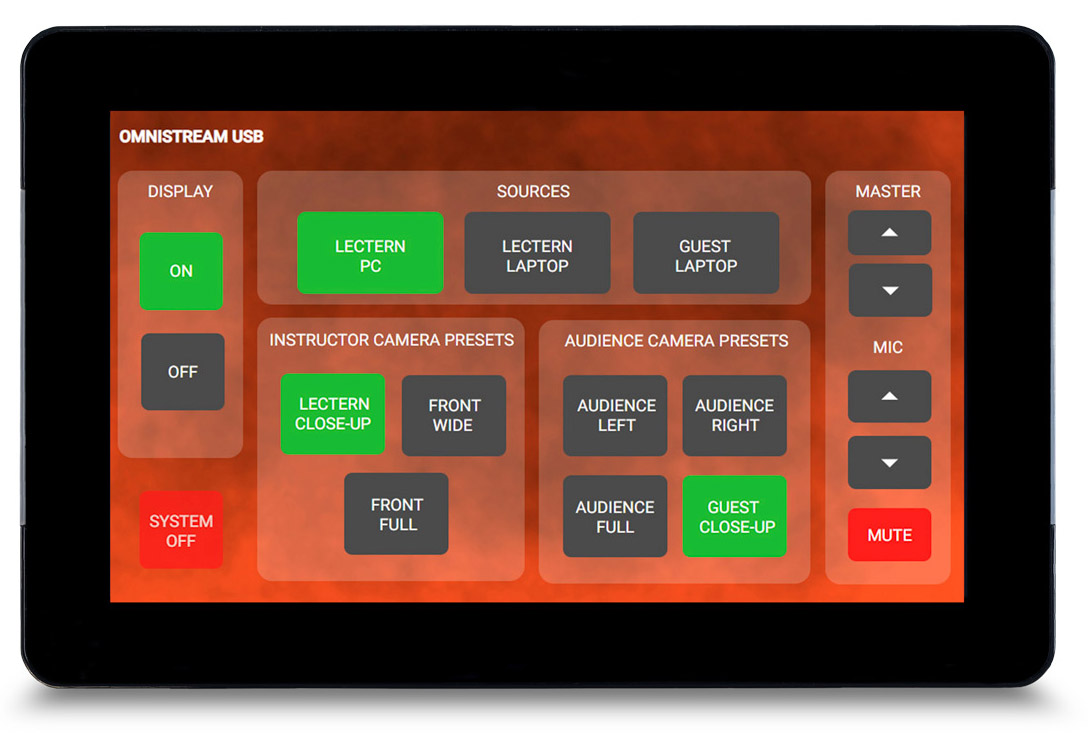
Sample Velocity touch panel user interface configured to trigger a specific USB Device Manager preset depending on which source is selected
Atlona USB Over IP Solutions
In addition to streaming audio and video over IP, Atlona’s OmniStream™ networked AV platform also supports transport of USB signals. It provides tremendous flexibility and scalability for USB systems. Host endpoints can connect to multiple device endpoints throughout the room, and hosts can be dynamically switched to allow different presenters to utilize the USB peripherals. Below are Atlona OmniStream products that support USB over IP:
- AT-OMNI-311 – OmniStream USB Host to IP Adapter with One USB-B Host Port
- AT-OMNI-324 – OmniStream USB Device to IP Adapter with Four USB-A Device Ports
- Velocity™ – IP-based AV Control System
- USB Device Manager – Velocity Driver for Configuring and Managing OmniStream USB Systems